
Pedal Build :: Liquid Sunshine

IMG_0276

The pedal Liquid Sunshine is an overdrive effect which, like many others, attempts to emulate the tone of a tube amplifier. After using it for a while, I have to say, it comes pretty close! While it’s not necessarily that touch-sensitive, it does distort in a very creamy and pleasant fashion. It uses JFET transistors for amplification which are well known for emulating the soft-clipping characteristics of vacuum tubes.

Check out the schematic, pics from my build, and most importantly, sound samples! One sample is a lower gain setting; the other with higher gain. Both samples are played with an 80′s Gibson Les Paul Special through a Johnson Reptone 15W amp.

Sound samples:
Liquid Sunshine high gain demo

Liquid Sunshine low gain demo

schematic

IMG_0238

IMG_0239

IMG_0240

IMG_0254

IMG_0276

IMG_0275

How to Tune Your Guitar

Tuning your guitar is an important skill to learn early on, because let’s face it, nobody sounds good playing an out-of-tune instrument.

There are actually *several* different ways to tune a guitar. Let’s go through them:

1. Using A Tuner
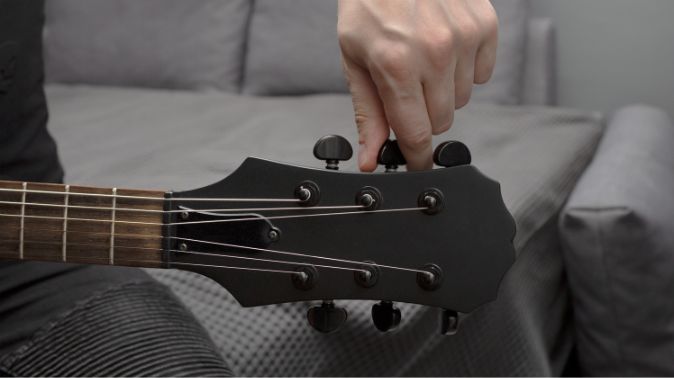
The most common way to tune a guitar is to use a Tuner, which is just a little electronic device that “listens” to your strings and tells you what note you’re playing. You have to turn the tuning pegs on the guitar until the strings are all turned to the correct tightness.

Here is a video which takes you through the process, quick and easy:

Video coming very soon!

2. Using An App on Your Smartphone, or Another Instrument
Since just about everyone has a smartphone, there are a myriad of free apps available to help you tune your guitar. This can be even more handy than using a separate tuner because everyone has their phone near them. The only drawback is that these apps may only give you notes for Standard Tuning (a guitar can be tuned to many different “altered” tunings).

Here is a video using one free tuning app on the Apple App Store called “Guitar Tuner” (imagine that):

Video coming very soon!

Instead of an app, you can also use any instrument that is already in tune. For example if you are playing guitar with a friend, just have him or her play each string one at a time and you can turn your tuning pegs until you match them. It doesn’t even have to be another guitar – you could use a piano too! Anything that can play the same notes you need to tune to.

3. Using Just the Guitar
This is the coolest way to tune your guitar in my opinion, and the only catch is that you have to be able to tune a single string by ear. If you can do that, you can actually tune all the other strings based on that.

In standard tuning, the strings are all tuned a certain number of frets apart from each other. In fact, they are all 5 frets apart, except for the G and B strings, there are only 4 frets between those.

So for example, if you tune the 6th string (low E) by ear, what you do next is play the 5th fret of that string. That note is A, the same A that the 5th string should be tuned to. So just as in method #2 using a smartphone app, you just compare the 5th string to the 6th string, 5th fret until they match. When finished, you have tuned a string without using anything other than the guitar itself!

You can continue this method for the remaining strings too, until they are all tuned.

My suggestion is that you always try to use this method. Memorize what the 6th string (low E) sounds like. Use a song like Led Zeppelin’s Communication Breakdown which starts out by playing that E note several times in a row to help you remember. Once you’ve got it, you’ll never need anything to tune your guitar again!

If you found this post helpful, please share it!

A simple guitar DSP system…from the ground up!

Simple, easy, DSP for guitar effects.

I will update this post with more info about this project soon!
Until then, you can find more info at my DIY Stompboxes forum post on the topic.

A concert-worthy system…in my basement.

A custom home audio system you won't see anywhere else...based on the infamous Don Keele's research!

With an overwhelming number of options on the market for home audio, it’s refreshing to see something so original, unique, and just plain awesome. It’s the CBT36 (Constant Beamwidth Transducer).

The CBT36 is a curved speaker array, based on declassified Naval military research. The research describes a perfectly spherical “cap-shaped” transducer which results in completely even sound coverage, independent of frequency. This of course is the goal of any audio system; deliver an identical experience to every physical location within a listening space. You can read the actual research papers and more on how Don Keele, a huge name in the audio industry, applied it to the CBT36, by visiting his site here.

I was instantly inspired and was encouraged by coworkers to make my own version of the CBT36, using more available parts. Luckily, my place of business provided the speakers, MDF, hardware, etc, and the expertise I needed to undertake the project.

This post is a work in progress and will be updated very soon!

You can check out the CBT36 available from Parts Express here for a cool $8,000 or you can purchase the kit and assemble it yourself for around $2,000.

Never miss a beat! Subscribe now -->

Thanks! Check your email to confirm your subscription :)

Powered by WordPress | Designed by: buy backlinks | Thanks to seo, seo services and Insanity Workout